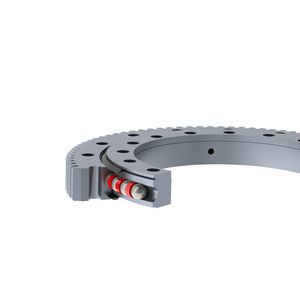
Rotary Stages & Tables
Indexing tables, rotary stages, slew rings and turntables.
Also searched as: rotary tableslew ringturntable bearingindexerrotary stage
-
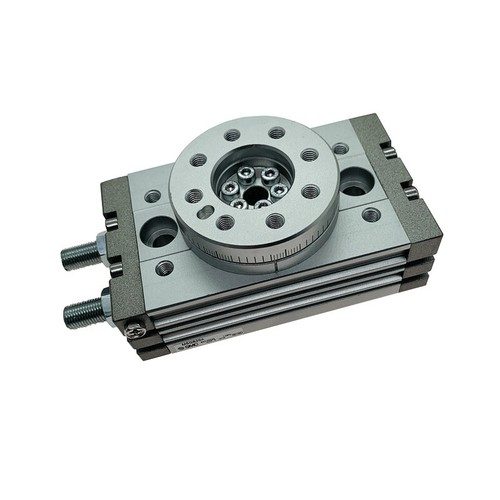
Rotary Table
Rotational Adjustment: 0° to 190°
-
-
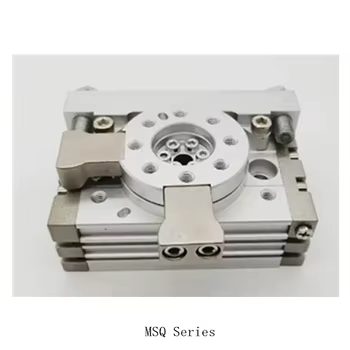
About rotary stages & tables
Rotary stages and tables are precision positioning devices that provide controlled angular motion for a wide range of industrial and scientific applications. These components facilitate indexing, precise angular alignment, and continuous rotation of workpieces or sensors. Key variants include indexing tables, which offer discrete, repeatable angular positions, and rotary stages, designed for continuous, high-precision motion often with closed-loop feedback. Slew rings and turntables typically handle larger loads and provide robust rotational support, often with integral gearing or bearing races.
Selection is primarily driven by load capacity, defined by axial, radial, and moment loads, and the required positional accuracy, expressed in arcseconds or arcminutes. Other critical specifications include rotational speed, acceleration, and the range of motion. Drive mechanisms vary, encompassing worm gears, direct drive motors, and belt drives, each offering different trade-offs in terms of backlash, stiffness, and speed. Common materials for housings include aluminum alloys (e.g., 6061-T6) for lighter duty applications and cast iron or steel for higher rigidity and load-bearing capacity. Bearing types range from crossed roller bearings for high precision and stiffness to ball bearings for smoother, lower-friction rotation, and plain bearings for heavy-duty, lower-speed applications. Surface finishes often include anodization for aluminum and black oxide or paint for steel components to enhance corrosion resistance.
How to choose
When selecting a rotary stage or table, first define the required load capacity, considering axial, radial, and moment loads. Second, determine the necessary positional accuracy and repeatability, often specified in arcseconds, to meet application requirements. Third, assess the required rotational speed and acceleration, which will influence the choice of drive mechanism (e.g., direct drive for high speed, worm gear for high torque and accuracy). Fourth, consider the environment: does it require sealed units for dust/moisture protection, or specific materials for chemical resistance? Finally, evaluate the physical constraints, including the overall diameter, height, and mounting interface, to ensure compatibility with existing systems.