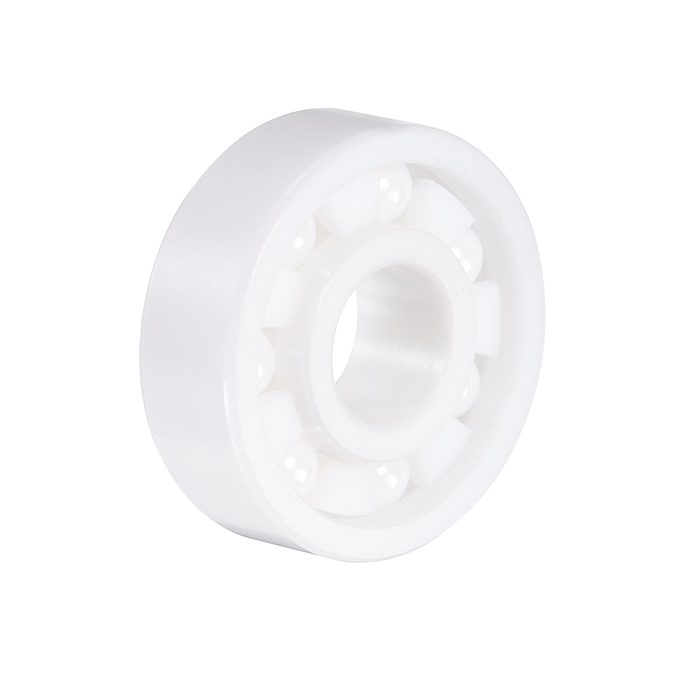
Ball Bearings
Deep groove, angular contact, thrust and self-aligning ball bearings.
Also searched as: deep groove bearings608 bearingangular contactsealed bearings
-
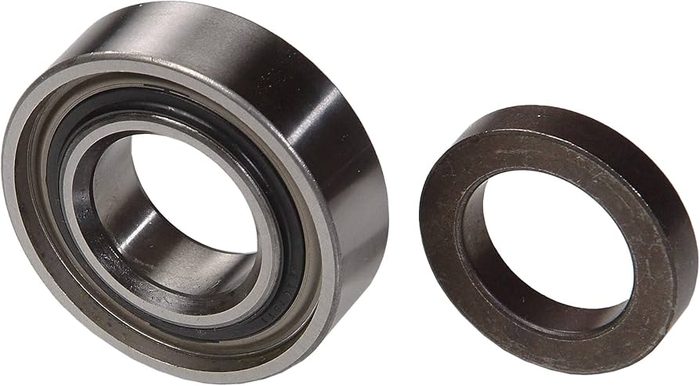 from $19.70Home Depot $19.70
About ball bearings
Ball bearings are rolling-element bearings that reduce rotational friction and support radial and axial loads. They consist of an inner and outer ring (races), a set of balls, and a cage to space and retain the balls. Common types include deep groove ball bearings, suitable for high speeds and moderate radial and axial loads, often specified by their bore, outer diameter, and width (e.g., 6000 series, 6200 series, 6300 series). Angular contact ball bearings are designed to accommodate combined radial and axial loads, with a contact angle that dictates axial load capacity. Thrust ball bearings are used for purely axial loads, while self-aligning ball bearings compensate for shaft misalignment. Key selection parameters include bore diameter (d), outer diameter (D), width (B), dynamic load rating (Cr), static load rating (Cor), and limiting speed. Materials typically include high-carbon chromium steel (e.g., AISI 52100), with options for stainless steel (e.g., AISI 440C) for corrosion resistance. Seals (e.g., ZZ, 2RS) and shields (e.g., Z, 2Z) are available to protect against contaminants and retain lubricant.
How to choose
How to Choose Ball Bearings
1. What are the load types and magnitudes? Determine if the application involves purely radial, purely axial, or combined loads. This dictates the primary bearing type (e.g., deep groove for combined, thrust for axial only, angular contact for high combined). Static and dynamic load ratings (Cor, Cr) must exceed application requirements. 2. What are the speed requirements? High rotational speeds necessitate bearings with appropriate limiting speeds, often influenced by cage design and lubrication. 3. Are there alignment issues? If shaft misalignment is expected, self-aligning ball bearings may be necessary. 4. What are the environmental conditions? Consider temperature, potential for contamination, and moisture. This determines lubrication type, sealing options (e.g., sealed bearings like 2RS), and material selection (e.g., stainless steel for corrosive environments). 5. What are the dimensional constraints? Bore diameter, outer diameter, and width are critical for fitting into the assembly.